Dubai Delivery Motorcycle Monitoring: Mandatory in 2027
On this page
- 1. What the RTA announced
- 2. The device sits on the bike, not the warehouse
- 3. What it actually measures
- 4. Coordinates versus behaviour
- 5. Three decisions before you install
- 6. Seven months of optional delivery motorcycle monitoring
- 7. The rules landing on 1 January 2027
- 8. What Saudi operators should take from it
- 9. For tracking providers
- 10. Frequently asked questions
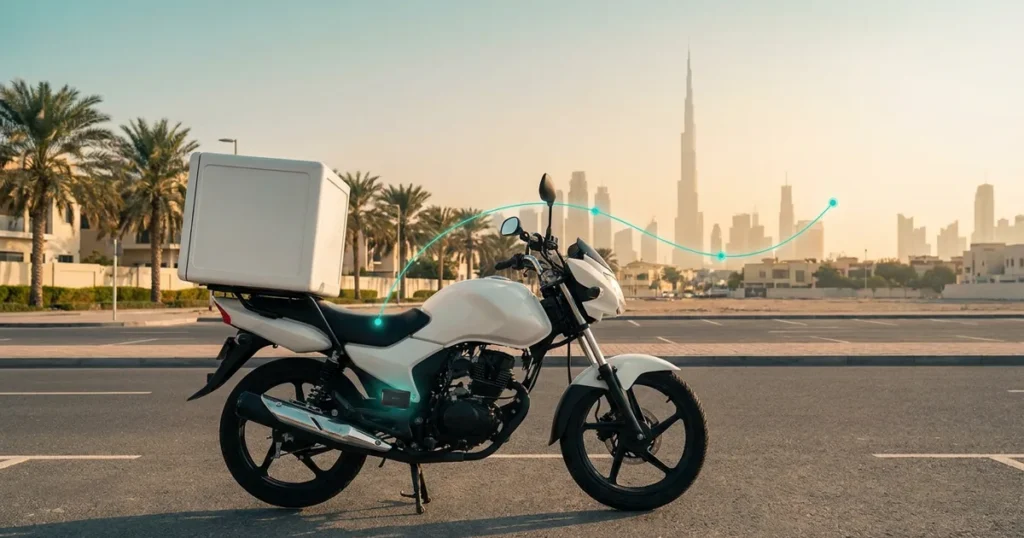
Dubai is building a delivery motorcycle monitoring system that puts an IoT device and a camera on the motorcycle itself. It stays voluntary until the end of June 2027, then becomes mandatory. The detail worth stopping on: the equipment does not just record where the bike went. It records how it was ridden.
Does your device measure behaviour?
Speed, acceleration, braking, riding patterns and route — from one unit on the bike.
What the RTA announced
Dubai’s Roads and Transport Authority announced a delivery motorcycle monitoring system that combines three parts: an electronic platform, IoT monitoring devices, and advanced cameras fitted to the motorcycles themselves, as reported by Gulf News on 2 November 2026.
The stated aim is to collect and analyse data on how riders operate their vehicles. Saeed Al Ramsi, Director of Licensing Activities Monitoring at the RTA, described it as a major shift in how delivery activity is monitored, and said the initiative moves the authority away from conventional inspections towards proactive monitoring built on real-time data. The system was developed with Dubai Police and other authorities.
That framing matters more than it first appears. An inspection is a sample taken on a given day. Delivery motorcycle monitoring is continuous, and it produces a record that exists whether or not an inspector is present.
The timetable is the message. Fitting the devices and connecting to the platform is voluntary from launch until the end of the first half of 2027, and mandatory afterwards. Operators who hear “voluntary” and wait are reading the word backwards: it is a deadline with a support window attached.
The device sits on the bike, not the warehouse
Most delivery systems measure what happens inside the warehouse or inside the app: pickup time, drop-off time, customer rating. All of those measure the outcome, not the road that produced it. Delivery motorcycle monitoring moves the sensor onto the vehicle, and that single change alters three things.
- Who measures. The regulator, through its platform — not the operator through a report it writes about itself.
- What is measured. Riding behaviour as it happens, rather than a total duration at the end of a shift.
- Who carries the burden of proof. The operator, because the data reaches a third party and not only the company.
This is why a tracking app that shows a dot on a map cannot satisfy the requirement. What the authority is asking for is not a location feed. It is a stream of behaviour indicators that can be read against a standard.
What delivery motorcycle monitoring actually measures
For delivery motorcycle monitoring, the authority listed five indicators, collected per trip.
| Metric | What it reveals | Where the data comes from |
|---|---|---|
| Speed | Limit breaches inside and outside the city | GNSS plus time |
| Sudden acceleration | Hard launches that precede many crashes | Accelerometer |
| Hard braking | Late reactions and short following distance | Accelerometer |
| Riding patterns | Repeated behaviour rather than one incident | Aggregated trip analysis |
| Location and route | Departure from the licensed operating area | GNSS plus geo-fence |
Read the third column carefully, because it is where procurement decisions go wrong. Speed can be derived from position over time. Acceleration and braking cannot. They need an accelerometer inside the unit. A device without one delivers three of the five metrics, and the shortfall only shows up when the platform is asked to produce a behaviour report.
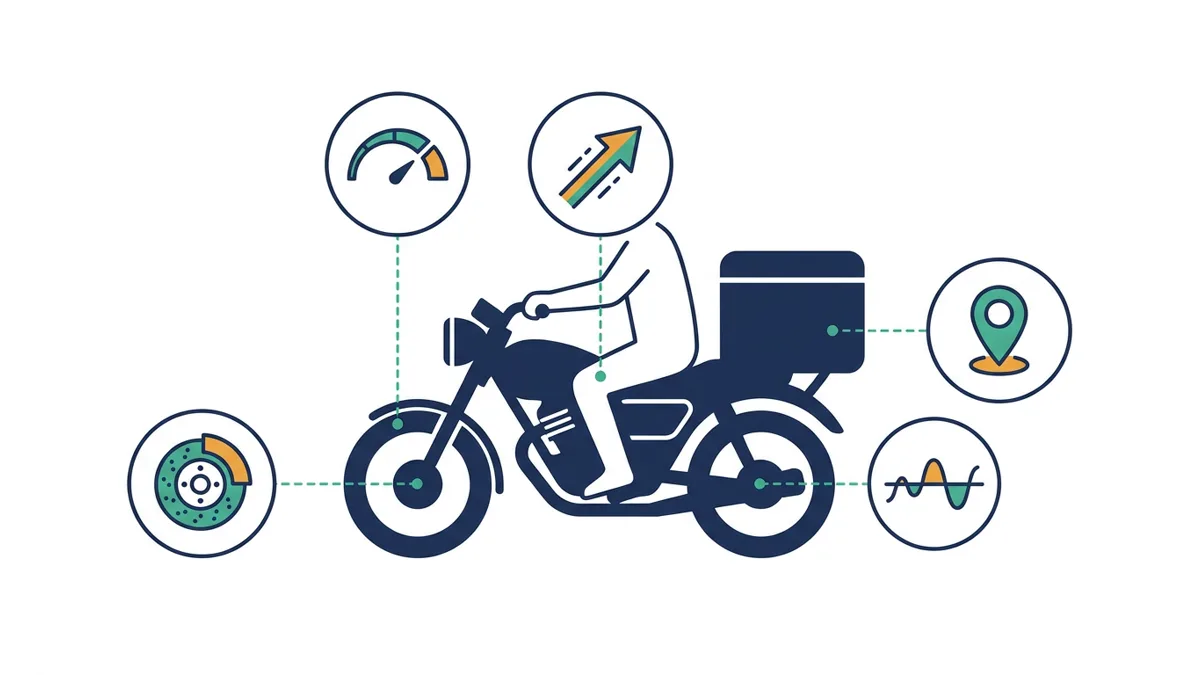
Delivery motorcycle monitoring: five indicators, two of which never appear on a map.
Coordinates versus behaviour
The distinction between a location device and a behaviour device decides which supplier can serve this market, so it deserves its own comparison.
| Dimension | Location device | Behaviour device |
|---|---|---|
| What it outputs | A position point every interval | Speed, acceleration, braking and pattern scores |
| What it can prove | That the bike was somewhere | That it was ridden a certain way |
| Compliance fit | Partial | Matches what the authority listed |
| Operational value | Tracking and dispatch | Training, appraisal, reports |
| Hardware needed | GNSS module | GNSS, accelerometer, platform integration |
This table explains why the authority calls it a shift rather than an addition. Anyone selling into delivery motorcycle monitoring has to answer for the second column, not the first. Delivery motorcycle monitoring does not add a box to the bike. It changes the evidence accepted at assessment: from “where was this motorcycle” to “how was it ridden”.
Three decisions before you install
Choosing hardware for delivery motorcycle monitoring runs through three decisions that rarely appear in a sales brochure, and each one determines whether the system produces usable data.
First, mounting position. A unit on a delivery motorcycle lives in conditions a truck-mounted device never sees: rain, daily pressure washing, constant vibration, and a higher chance of tampering because the bike stands in the street. A protected mounting point is not cosmetic; it is what keeps the readings continuous.
Second, the accelerometer. This is the technical line between two devices that look identical on paper. Sudden acceleration and hard braking cannot be reconstructed from coordinates, so an operator who buys a GNSS-only unit for delivery motorcycle monitoring discovers the gap during assessment rather than during purchase.
Third, the camera and its retention policy. A camera on a motorcycle sees what a warehouse camera never does: the road, pedestrians, and other vehicles’ plates. Deciding who may review footage, how long it is kept, and who can delete it matters as much as the camera specification.
All three are settled before purchase, not after. Changing them later is not an adjustment — it is refitting an entire fleet inside a shrinking window.
Seven months of optional delivery motorcycle monitoring
The RTA said it will keep working with delivery companies during the transitional period and support them as they prepare. That support is useful, but the calendar is fixed. Five tasks belong in the window between now and July 2027.
- Audit the fleet. Separate motorcycles licensed for delivery from any vehicle used for something else — the obligations do not apply uniformly.
- Test the hardware. Confirm the unit has an accelerometer and can export behaviour, not only position.
- Set the geofences. Define operating areas and permitted stopping zones before any pilot run.
- Run in observe-only mode. Two to three weeks of delivery motorcycle monitoring with no enforcement, compared against what the company already believes about its riders.
- Write the camera policy. Review access, retention period and deletion rights before the first camera is switched on.
The expensive mistake in this window is buying late. The final month before the mandate will not fit a full fleet install, an integration test, and the discovery that the chosen unit cannot produce two of the five metrics. Operators who start in June pay for it in July.
The rules landing on 1 January 2027
The Dubai system does not arrive alone. From 1 January 2027, wider federal obligations apply to delivery riders and delivery-vehicle operators under the implementing regulations of Federal Decree-Law No. 14 of 2024, as Gulf News reported on 7 November 2026. The regulations set eight obligations, including:
- No backpacks for orders. Riders must use approved equipment mounted on the vehicle.
- No passengers. Carrying a passenger on a delivery-licensed motorcycle is prohibited.
- Approved equipment and uniform. Both become conditions of operating.
- A valid professional permit. Riding without one is no longer an option.
The overlap is the part operators underestimate. The January rules concern the vehicle and the rider; delivery motorcycle monitoring concerns the data. An operator who prepares for the first and ignores the second ends up compliant on paper and non-compliant in the platform — at the same time.
What Saudi operators should take from it
The difference between the two markets is not technology. It is the order in which regulation arrived. Saudi Arabia started with licensing: the delivery orders licence sets the categories and the obligations on the establishment, and motorcycle goods transport has its own operating conditions.
Dubai has added the layer that sits after licensing — measuring behaviour and connecting it to the regulator’s platform. The pattern worth preparing for is the move from “are you licensed” to “can you show how your vehicles are driven”, because the second question is the one that produces data policy can be built on.
For an operator in Saudi Arabia, that preparation needs no mandate: delivery motorcycle monitoring is a capability before it is a rule. A unit with an accelerometer, a platform that reports behaviour per rider, and a time-stamped record are the same three ingredients Dubai is asking for. Building them early costs less than retrofitting them under a deadline.
For tracking providers
If you sell tracking hardware or platforms, this is the most useful reading of the announcement.
The buyer changes. Delivery motorcycle monitoring turns a device sale into a compliance sale. The customer is not buying a map; they are buying evidence that survives an assessment.
The qualifying question is technical. “Does it have GPS” is the wrong question. The right one is: does the unit carry an accelerometer, and can the platform export per-trip behaviour in a format the authority’s system can read?
Cameras are a second product line. A device plus camera on the bike brings in capability most tracking resellers do not currently carry, and it opens the retention-policy conversation — which is a service, not a box.
The window is a selling season. Seven months of voluntary adoption is a long runway. Providers who spend it running pilots will have reference fleets when the mandate lands; those who wait for July will be installing against a queue.
The cheap option loses later. An operator who buys the lowest-cost GNSS-only unit will discover the gap at the worst moment, and will remember who sold it.
The short version: delivery motorcycle monitoring moves tracking from an operations tool to a compliance tool. What the operator pays for is not the device. It is the ability to produce behaviour indicators that connect to the regulator’s platform before July 2027.
If you are fitting a fleet now, our GPS trackers available in Saudi Arabia covers the units we supply and support, and motorcycle tracker options sets out the technical differences that decide which unit can deliver the five metrics.
Getting ready before the deadline?
Tell us your fleet size and we will tell you what the install actually involves.
Frequently asked questions
When does delivery motorcycle monitoring become mandatory in Dubai?
Fitting the devices and connecting to the platform is voluntary from launch until the end of June 2027, and becomes mandatory after that date.
What does the system measure?
Speed, sudden acceleration, hard braking, riding patterns, and location and route — collected through an IoT device and a camera fitted to the motorcycle.
Will an ordinary GPS tracker be enough?
No. Acceleration and braking need an accelerometer inside the unit, and the data must reach an approved platform. A GNSS-only device produces three of the five metrics.
Do the rules apply to companies or to riders?
Delivery motorcycle monitoring addresses the company, in respect of the platform and reporting. The federal rules effective 1 January 2027 address the rider and the delivery-vehicle operator, in respect of equipment, uniform and permits.
Does it cover electric delivery bikes?
The announcement refers to delivery motorcycles operating on the emirate’s roads and notes their growing number as the sector expands. Exact categories will follow from the authority’s implementing detail.
Is this relevant outside the UAE?
As a template, yes. It shows what regulators ask for once licensing is settled: not a location feed, but behaviour data that can be audited. Fleets in Saudi Arabia can build the same delivery motorcycle monitoring capability before anyone requires it.
Related reading
GPS trackers available in Saudi Arabia
The units we supply and support.
Which units deliver all five metrics.